WHAT IT IS
A model with a paper trail
You have a document that holds the rules: a rate card, a published table, a contract schedule, a regulation. Someone has to apply it repeatedly, at speed, without re-reading it each time. This builds the workbook that does what the document says, plus the log showing where each figure came from.
The build is not the hard part. Plenty of people can produce a file that returns numbers. The difference is that when somebody later asks why a particular figure is what it is, there is a line in the log naming the document, the page and the edition date, with the arithmetic between the source and the cell written out.
THE SOURCE
What counts as a usable source
The model is only as defined as the document behind it. A usable source is one where two people would extract the same figures.
- Published tables and schedules: rates, bands, tariffs, fee scales.
- Contracts with defined calculation clauses.
- Regulations and official publications with the figures stated in them.
- Internal rate cards and price lists, provided one version is authoritative.
TRACEABILITY
Every figure has an address
What does not work is a source that lives mainly in someone's head, or four spreadsheets that disagree. Where that is the situation, the first job is settling which document wins. That decision is yours; I will show you where the versions conflict.
Traceability is built during the work rather than written up afterwards. Each figure the model produces gets a row in the reconciliation log as it is built.
- The output: sheet, cell, and what the figure represents.
- The value the model produces.
- The value stated in the source.
- The source's title, page or table reference, and edition date.
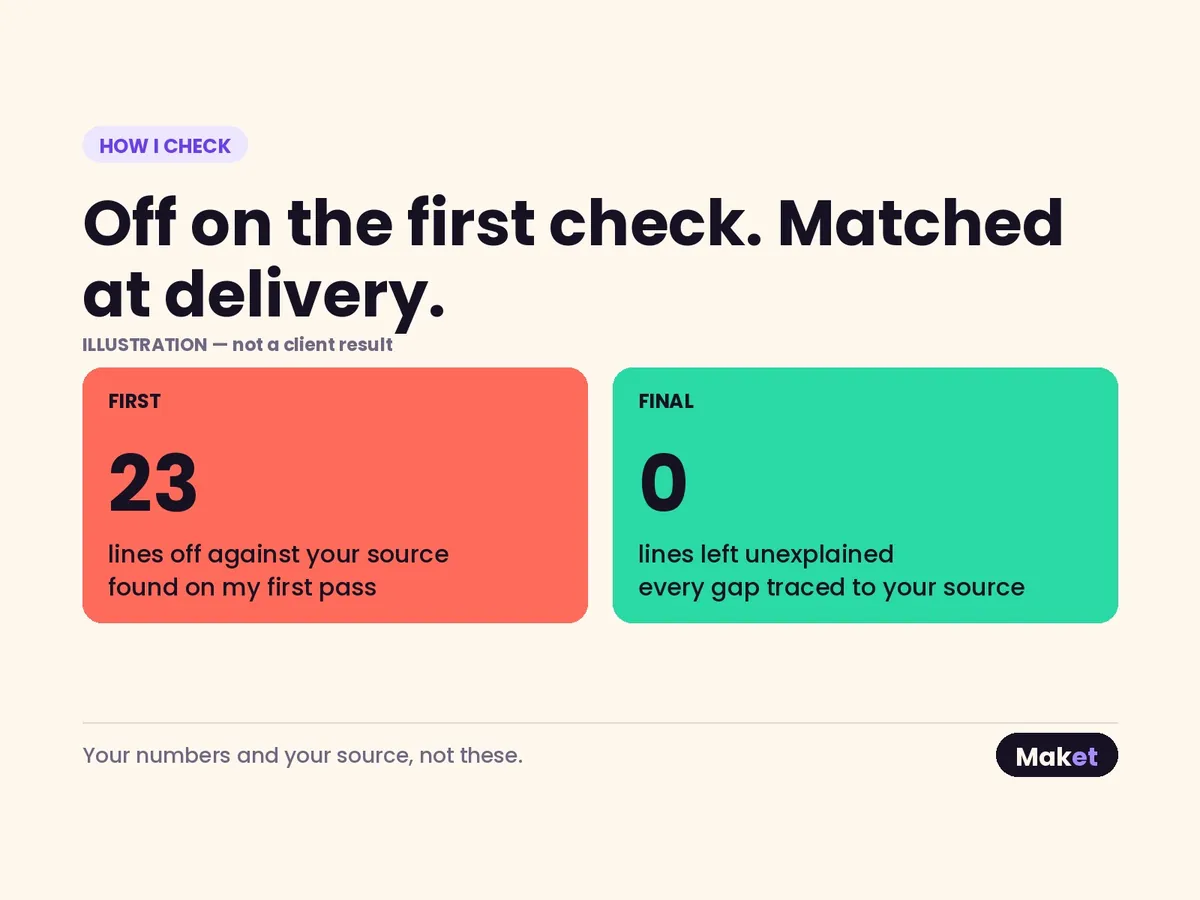
- Match, or mismatch with the difference.
- For derived figures, the arithmetic connecting source to output, written out.
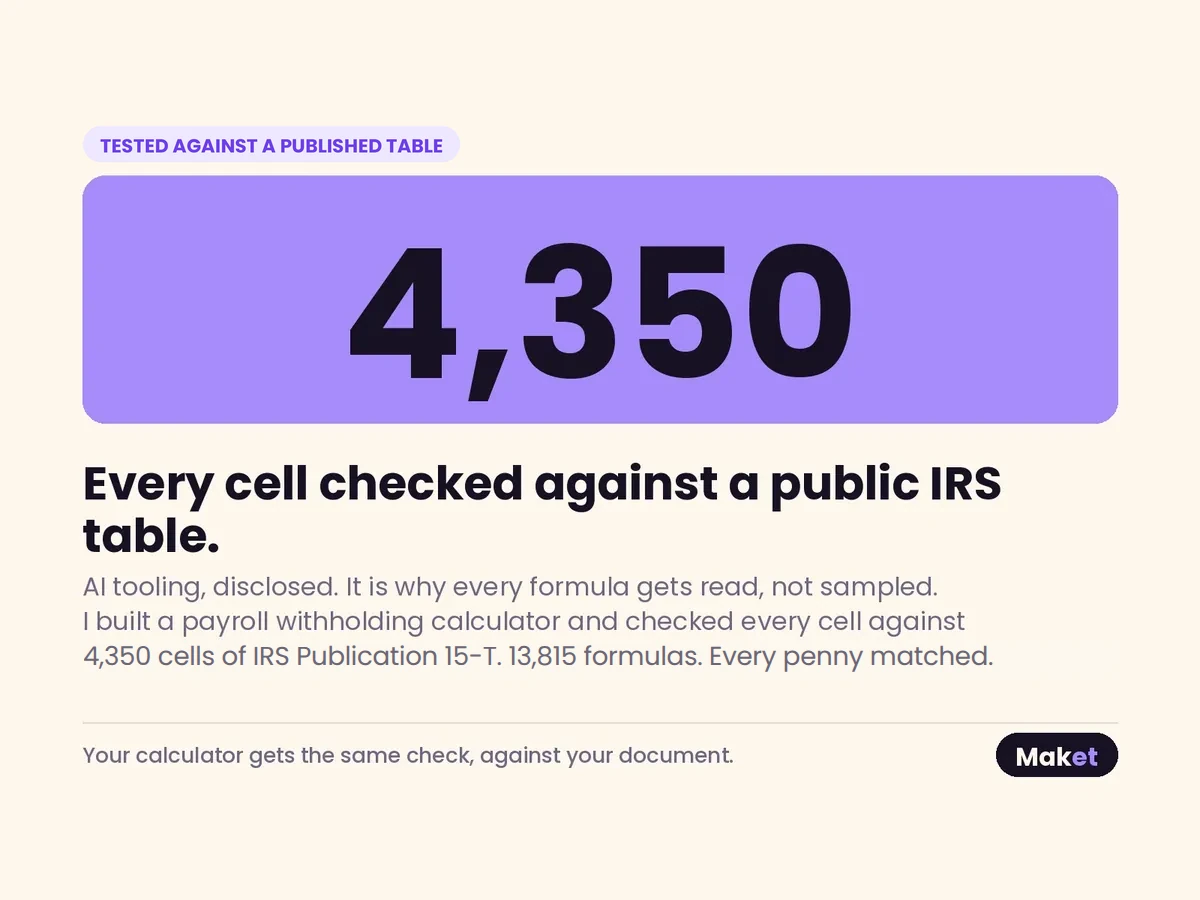
Where the source states a figure, the model reproduces it exactly. Where the model derives one, the derivation is shown so it can be argued with.
WHAT YOU RECEIVE
The file and the evidence
Delivery is the workbook and the material that makes it checkable.
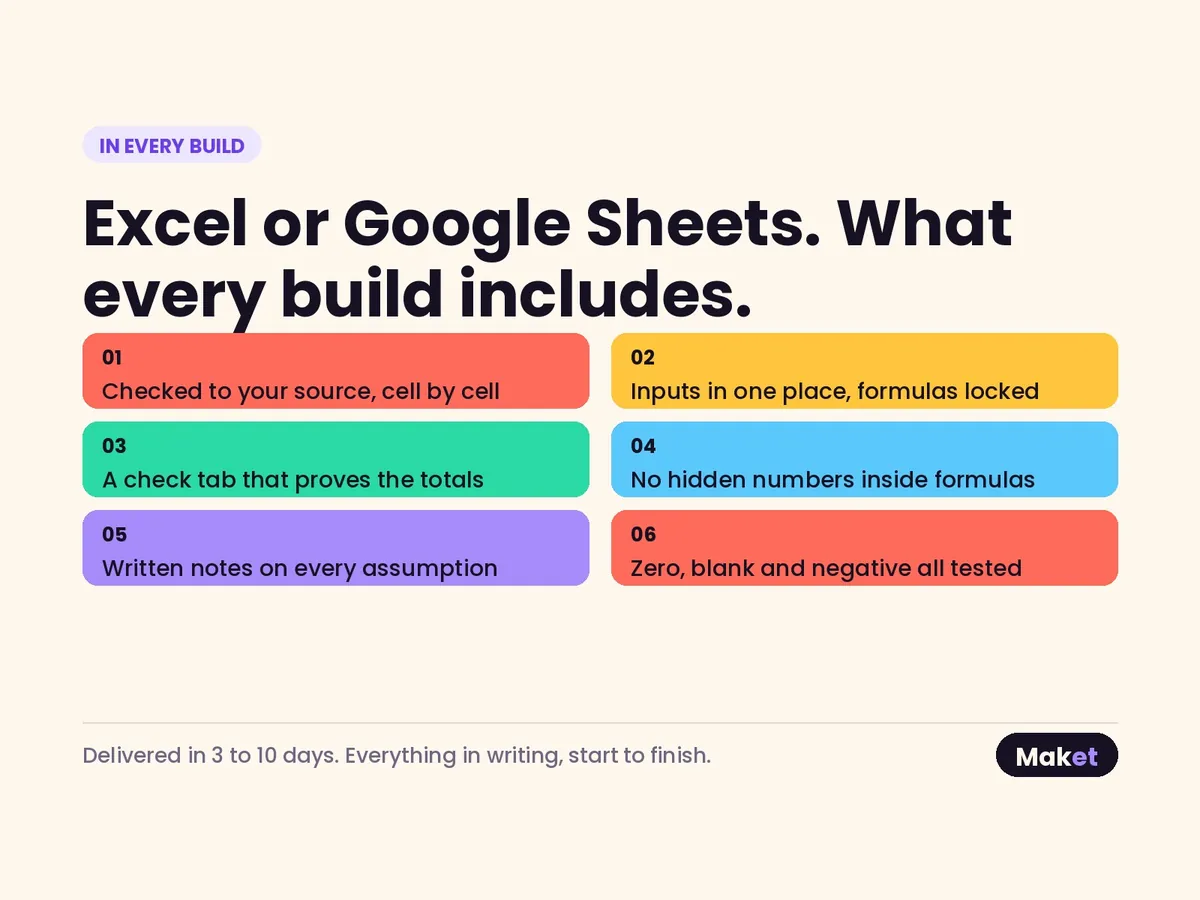
- The workbook, with inputs separated from calculation and calculation separated from presentation.
- The reconciliation log, inside the file, with one row per figure.
- A note of the exact source edition the model was built against, so you know what to re-check when a new edition appears.
- A list of anything the source does not settle, with the assumption used instead, stated as an assumption.
AI
AI builds fast and invents quietly
AI tooling is used in the build, and I would rather state that than be asked. It is quick at structure and quick at formulas.
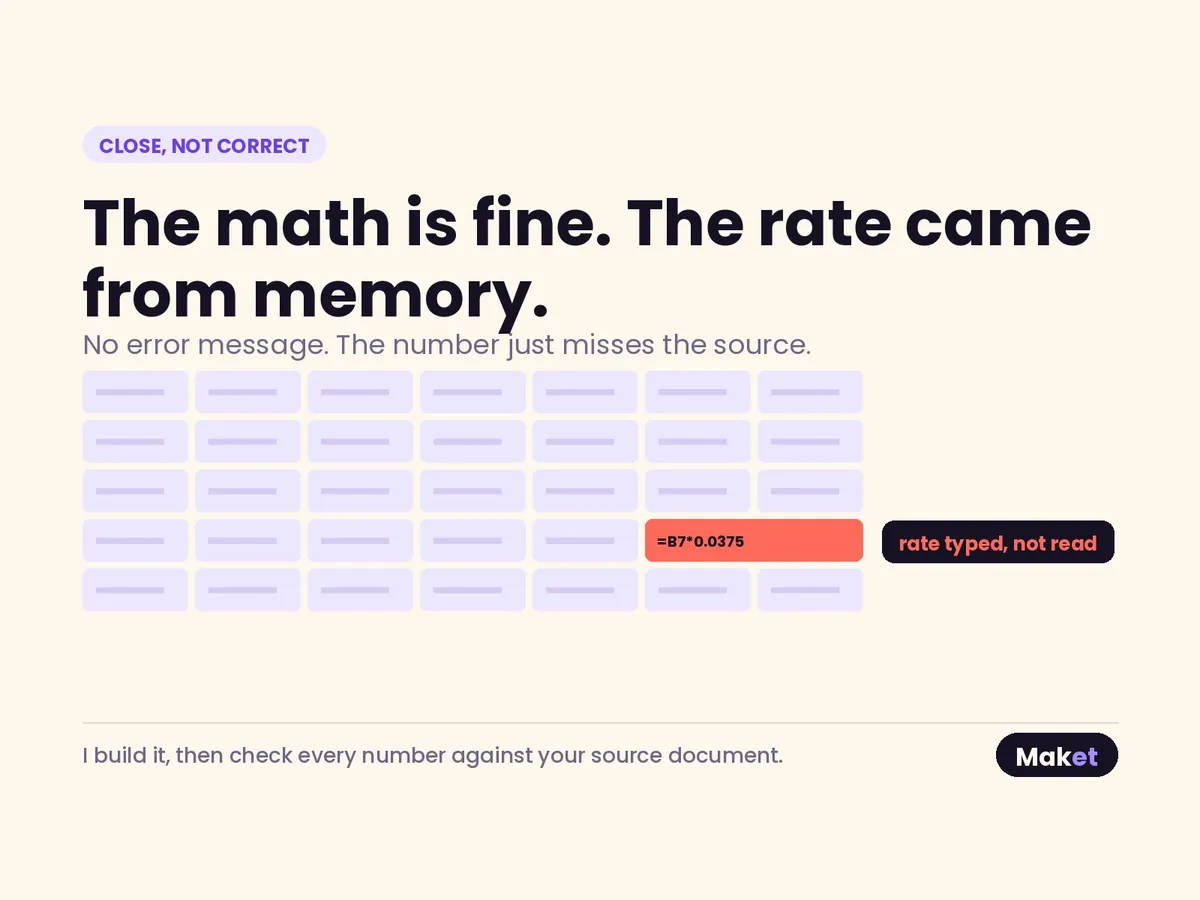
It will also produce a bracket that looks like the published one, a rate near the real one, a rounding rule that fits the pattern of the surrounding rows and appears nowhere in the source. That is the reason the reconciliation exists in this form. Every figure in the finished model is checked back to the document and recorded with page and date, so what you are buying is not confidence in the builder. It is a file you can verify without me.